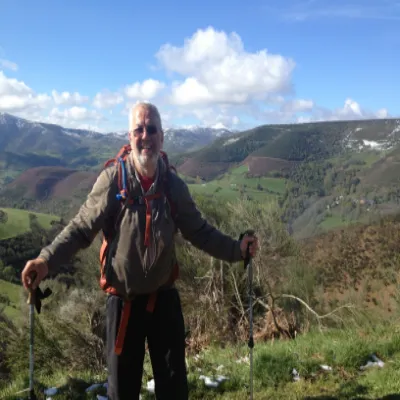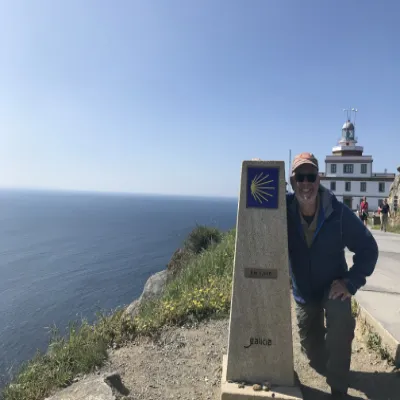

Two peaks bookend fifty kilometers (roughly thirty miles) of this stage of The Way. The magnificent Templar Castle in Ponferrada sits at five hundred forty meters (one thousand seven hundred seventy feet). A mercifully gentle, level grade follows as the trail weaves westward through the delightful ancient city of Villafranca de Bierzo.
What a contrast occurs in the last seven kilometers (four and a quarter miles)! The trail spikes abruptly seven hundred meters (three thousand feet) — that’s two Washington Monuments perched one atop the other. As another comparison, the ascent was the height of three Eiffel Towers stacked one atop the other. The climb rewards with views from the medieval mountain village of O’Cebreiro (pronounced O thay bray air o). This village has existed since the 9th century as a place to assist pilgrims on their journey to Santiago. The town holds a profound respect for a miracle that occurred there.
O’CEBREIRO
As brutally exhausting as the ascent is, pilgrims are eager to grab a bunk here and revel in the mountain panorama. Most find themselves dumbstruck by the commanding view of the sweeping mountainscape stretching to the horizon. One sits speechless at the warm butter-yellow, gold, and tangerine-colored sunsets and sunrises. This setting serves as a theatre for God’s creation at play.
A treasured historical event occurred in O’Cebreiro that prompts a soul search. It occurred in the town’s small church, Santa Maria la Real, tucked right along the Camino trail. The church sits alongside the portion of the trail that roller coasters steeply up and down through hills and valleys. During the 14th century, a pilgrim chose to brave a fierce snowstorm to get to a mass service at the church. The trail was treacherous, to say the least. He arrived at the church only to be met by a visiting monk who chided him sternly, “You could have been killed. You could have fallen down the mountainside, or been lost in snow where no one could find you.” Then the monk added, “No one else is here. What are you here for?”
Local history captured his simple response.
“I am here for Jesus.”
How could the pitiless monk refuse? He agreed to celebrate the mass for this one congregant.
During the most sacred moment of the mass, a miracle occurred. The celebrant elevated the bread wafer, the host. Before their eyes the host transformed into human skin, relaxed, and folded over the monk’s knuckles. He placed it upon the paten, a silver, plate-like vessel used during the mass. Completely stunned, the priest elevated the chalice, also made of silver, only to find that the wine had been transformed into human blood. It was reported that when this happened, another miracle occurred involving the statue of Mary holding the Christ child, situated on the wall alongside the altar. Both men witnessed Mary’s head turning toward this heavenly sign.
To consider, for the humble peasant, what he was there for was Jesus, and his faith was rewarded by Jesus being fully there for him.
Some seven centuries later in this little, ancient church is a side chapel with the statue. In a glass case set nearby is a striking red, velvet display holding the silver paten and chalice. To think, these two vessels held what some Christians believe was the transfigured body and blood of Christ!
It was just shortly after noon when the trail skirted an ancient country church. Oh, yes! Time for a brief stop and perhaps a noon pilgrim mass. I wanted to stop in to pray for those who had entrusted me with their burden words, and if possible, attend mass. I also had some things to get off my chest with our Father. I needed time on my knees.
I slipped into the small chapel only to see that the service had already begun. I tried, oh. . . so. . . hard, to be inconspicuous. That’s not easy with walking sticks tapping the old Spanish tile and a nineteen-pound backpack. The wooden pews were crowded tightly with kneelers, which made it impossible not to clank my way in unnoticed. First my backpack straps rattled on the bench, then my poles screeched across the floor. Regardless, I was finally able to settle in a spot in the last pew behind the pray-ers.
Unlike every church I’d attended on the Camino, the locals here did not seem welcoming. How peculiar?! In fact, I was getting disgusted looks and unwelcome glances. This is soooooo odd. After silently settling in, I noticed how beautiful the altar looked. It was crafted with an exquisite wood grain. Okay. Altars can be made with whatever. But also odd was that a woman was speaking in Spanish–at length mind you—and, from the pulpit! This also was not customary in a Catholic service. After her speech of which I understood not ..one..word, the priest walked down from behind the gorgeous wood altar to sprinkle holy water. Yes, a pilgrim blessing! I certainly need one!
An epiphany erupted. The sprinkling was not intended for the altar, nor for any pilgrim. The holy water was for a blessing over a wood coffin! And the deceased within it! The unwelcome glances had come my way because I had slid into a funeral service of one of the locals’ loved ones. Lord, forgive me! I crashed a funeral service! Needless to say, I quickly slunk out as silently as a clunky pilgrim could.
It was a classic “Willie being Willie.” I had honorable intentions for being there. I simply wanted time with the Lord. However, I hadn’t paid attention to the details or how others might perceive my actions. My thoughts quickly became self-shaming for not paying attention and for any pain I might have caused the grieving in that chapel. I’m sorry, Lord! I continued beating myself up and felt shame. I couldn’t find a way to forgive myself for my actions. This is typical of me–though I never deliberately intend to offend, many times I just miss the details. I do make mistakes, I do make oversights, I tend to try to do everything p e r f e c t l y. And I do wild things like crash a funeral service on rare occasions. I repeatedly poured through my litany of apologies and made my confession for being “an idiot.”
Suddenly, I sensed our Father speaking to my heart. “Willie. Enough. I understand. I hear your regret. I forgive you!”
My thoughts derailed. I realized sometimes I head to places thinking I know what I’m there for, but come to realize that what I’m there for is not as good as what God has me there for. I was not there to crash a funeral. I believe God had me there to really see myself more deeply–my faults, my weakness, and my tendencies toward struggling with self-forgiveness.
Forgiveness is not dependent upon me. It is dependent upon my acceptance of His forgiveness.
I felt the Holy Spirit’s encouragement.
What are you here for, Willie?
I am here for Jesus. I’m here for His love. I’m here for His forgiveness. Not my self-forgiveness, but His.
Surprising things happen on the Camino. This day enriched me when I accepted that I was “here for” a lesson on humility.